
Table of Contents:
1.The Condo/Townhouse Conundrum: Why Your Winter is Different
2.Beyond the Driveway: Anatomy of a Condo/Townhouse Winter Plan
3.Cracking the Code: Demystifying Winnipeg Snow Removal Contracts
4.The Ice Melt Arsenal: Chemistry for Safe Walkways
5.The Great Windrow Wars & Other Municipal Realities
6.From Reactive to Proactive: Building a Winter-Resilient Property
7.The Final Verdict: Mastering Your Micro-Climate
1. The Condo Conundrum: Why Your Winter Snow Removal is Different
Let’s have a real Winnipeg moment, shall we? You’re sipping your morning coffee, watching those first determined flurries of the season dust the shared courtyard. A part of you thinks, “How picturesque.” The other, more experienced part,the part that has battled slush-monsters in parking stalls and navigated ice rinks disguised as walkways groans inwardly, because you know what’s coming.
For property managers, owners and boards of condos and townhouses, winter isn't just a season; it's a complex logistical operation where a single patch of black ice isn't just a hazard—it's a potential liability shared by dozens of neighbors.

Welcome to the unique battlefield of Snow Removal for Winnipeg condos and townhouses. This isn't the single-family home game, where one person decides when to shovel the front walk. This is collective winter management, a dance of bylaws, budgets, contracts, unit owners and communal safety.
The city does its part, deploying 300+ pieces of equipment to clear over 7,200 lane kilometers of road, but once that municipal plow passes by, the responsibility for your property's paths, parking areas, and access lanes falls squarely on your corporation or HOA. The challenges are amplified: high-traffic pedestrian zones, sprawling parking lots, labyrinthine walkways, and the ever-present specter of slips, falls, and strained neighborly relations.
Slip and Fall Liability: Understanding Your Respobsibilities

This guide is your tactical manual. We’re moving past generic winter tips and into the nitty-gritty of what makes multi-unit dwellings a special kind of winter beast. We’ll decode city policies, tear apart service contracts so you know what you’re really signing, geek out on the science of ice melt, and explore how your very building design creates a "winter micro-climate".
Whether you're a board member vetting contractors, a property manager scheduling services, or an owner wondering where your fees are going, understanding this process is the first step to transforming winter from a source of stress into a season of (relatively) smooth sailing.
Related Reading: What Our Customers Have To Say About Sunshine's Snow Removal Services: Winnipeg Snow Removal Experts Serving Winnipeg For 30+ Years.
2. Beyond the Driveway: Anatomy of a Condo & Townhouse Snow Removal Plan
For a single-family home, winter prep might mean calling a guy with a plow for the driveway and keeping a bag of salt by the door. For your condo or townhouse complex, it’s a master plan that sometimes needs the precision of a military campaign. Every element of your property can present a unique challenge that generic Winnipeg residential snow plowing services might not automatically cover.
First, let’s map the battlefield:
Parking Lots & Garages:
These aren't just big driveways. They are high-traffic zones that can include tight turns, light standards, and designated accessible stalls that require meticulous clearing. Snow piles must be strategically placed to avoid blocking sightlines at entrances or taking up precious parking spots. The city is explicit: windrows (those ridges left by plows) blocking private entrances are the property owner's responsibility to remove.
Walkways & Pedestrian Access:
This is your highest-liability zone. A clear path from parking areas to building entrances, between units, and to mailboxes is non-negotiable.
The standard must be higher than a compacted snow surface; these areas often need to be cleared to pavement to prevent dangerous ice formation. Remember, the city clears its sidewalks to a compacted surface on residential streets, but your private walkways demand a higher standard of care.
Staircases & Entryways:
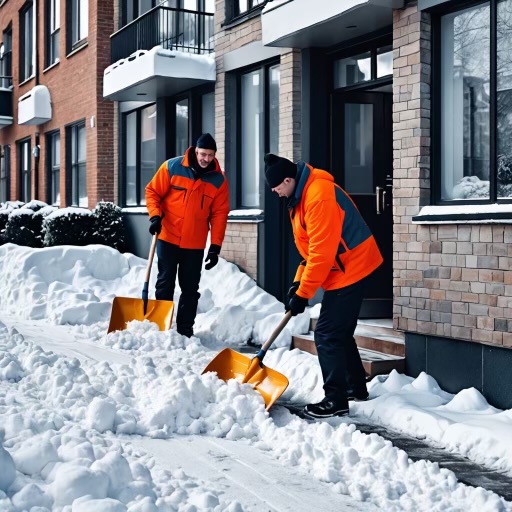
These are accident magnets. They require hand-shoveling or specialized snow-blowing, followed immediately by Winnipeg ice melt application services. Melting snow from boots often refreezes here into a perilous glaze within hours.
Common Amenity Areas: Patios, courtyards, playgrounds, and BBQ pits need attention, both for safety and to prevent damage from freeze-thaw cycles.
Roofs & Eaves (The Silent Threat):
While not always part of a standard removal contract, ice damming on roofs can cause catastrophic water damage. Proactive monitoring and potential snow removal from flat roofs or clearing of gutters is a critical, though often overlooked, component of winter care.
The takeaway? Your Request for Proposal (RFP) to contractors must be hyper-specific. Don’t just ask for “snow removal.” Detail every staircase, every walkway, the width of parking stalls, and the location of fire hydrants and accessible parking. The more detailed your plan, the more accurate the quote and the fewer “that’s not my job” disputes you’ll have after a blizzard.
Contact us today for your free estimate while we still have a few open spots in our schedule.
Reliable, Professional, and properly insured. Sunshine Maintenance with 30+ years of experience
3. Cracking the Code: Demystifying Winnipeg Snow Removal Contracts
If your winter plan is the battle strategy, the contract with your service provider is the treaty. And in the world of snow and ice, a bad treaty is worse than no treaty at all. This is where many boards and property managers should spend extra time and attention and where liability can skyrocket. Let’s translate the legalese.
A robust contract isn't just a price quote; it's a comprehensive rulebook. Here’s what must be in it:
The Trigger Point:
Exactly how much accumulation (e.g., 2 cm, 5 cm) triggers service? Is it per event or total accumulation over 24 hours? Don’t say “when it snows.” Be precise.
The Clock:
What is the response time after the trigger? 4 hours? 12? 24? This is crucial for mitigating liability.
The Map:
An explicit, attached site plan outlining every area covered: Lot A, Walkway B to C, Staircases 1-4, etc.
The Methods:
Is it plowing, blowing, shoveling, or a combination? Where will snow be piled? (Spoiler: Not in the accessible parking spot or blocking dumpsters).
Related Reading: 10 things Winnipeg condo boards should ceck before signing a snow removal contract
Ice Management:
This is a separate but related service. Specify when and with what products de-icing will occur (we’ll dive into the “what” in the next section).
For most condos and townhouses, the Seasonal Contract is the gold standard. It provides operational and financial predictability. The key is ensuring the contract’s scope—the triggers, responses, and areas—is ironclad, so you get the service you’re expecting.
Finally, insurance. The contract will sometimes require the contractor to provide a Certificate of Insurance naming your condominium corporation as an “Additional Insured.” If a contractor’s employee gets hurt on your property or their plow damages a building, their insurance should be primary, not yours.
Ready to chat about your snow management needs?

We look forward to helping you with your complex.
4. The Ice Melt Arsenal: Chemistry for Safe Walkways
Clearing the white stuff is only half the battle. The lurking, transparent menace of ice is what truly terrifies property managers. Applying ice melt isn't just a courtesy; it’s a critical safety procedure. But you can’t just dump a generic bag of “salt” everywhere. The wrong product can eat away at your concrete, poison pet-friendly areas, and kill your landscaping come spring.
Let’s break down the chemical brigade:
Sodium Chloride (Rock Salt):
The old standby. Cheap and effective down to about -9°C. The city uses it on Priority 1 & 2 streets. The Downside: It’s corrosive to concrete and metal, harmful to vegetation, and toxic to pets. It creates that infamous white, dusty residue that can get tracked into hallways and floors creating a mess.
Calcium Chloride:
Works in much colder temps (down to -25°C or lower). It releases heat as it dissolves (exothermic), giving it a fast kick. The Downside: It’s hygroscopic (draws moisture), leading to wet, slippery surfaces if over-applied. It can also be damaging to concrete and is more expensive.
Magnesium Chloride:
Effective to about -15°C. Less damaging to vegetation than rock salt but can still be problematic. Often used in “eco-blend” products.
Potassium Chloride:
Primarily a fertilizer. Its ice-melting ability is poor and it’s very costly. Not practical for large-scale use.
Urea:
Also a fertilizer. Melts ice poorly and is nitrogen-based, which can pollute waterways. Not recommended.
CMA (Calcium Magnesium Acetate) & Other Acetates:
The “premium” environmentally friendly option. Corrosion-free and much safer for concrete, pets, and plants. The Downside: It is significantly more expensive and less effective in extreme cold than chlorides.
Sand & Treated Abrasives:
These do not melt ice. They provide traction only. The city uses treated sand (with about 5% salt) on roads when temperatures dip below -7°C. It’s a critical tool for instant friction on slopes and stairs, but it tracks everywhere and leaves a mess to clean up.
The Professional Strategy: A top-tier Winnipeg ice melt application service won’t rely on just one product. They’ll have a mix:
Pre-Treatment (Anti-Icing): Applying liquid brine (often a salt mix, or even a beet-based solution like the city uses on bridges) before a storm to prevent bond.
Post-Treatment (De-Icing):
After clearing, applying solid pellets to melt residual ice and prevent refreeze. In pet-heavy or landscaped common areas, a chloride-free product like Safe Thaw may be specified.
Related Reading: 12 Eco-Friendly Snow Melt Alternatives; Brought to You by Sunshine Maintenance & Landscaping: Snow Shovelling Winnipeg Homes for 30 + Years!
Contact us today for your free estimate.
Abrasive Application:
Strategically spreading sand on steep slopes, stairs, and high-risk zones for immediate traction.
Your contract should specify not just that de-icing happens, but where, when, and with what types of products. Specify if you have pet-designated areas or new concrete that requires chloride-free treatment. This level of detail separates a professional service from a guy with a plow and a bag of cheap salt.
5. The Great Windrow Wars & Other Municipal Realities
You’ve hired a great contractor. Your walkways are clear and de-iced. Then, the city’s grader rumbles down your adjacent street or back lane in the dead of night, leaving a formidable, frozen berm—a windrow—blocking your parking lot entrance or burying a row of cars. The collective groan from your residents is almost audible. This, friends, is a rite of passage.
Related Reading: Who is Responsible for windrows left from City of Winnipeg Snow Removal
Understanding the city’s side of this relationship is paramount. Winnipeg operates on a three-tier priority system:
Priority 1 (P1): Major regional streets (Portage, Main). Cleared to bare pavement starting at 3 cm of accumulation.
Priority 2 (P2): Collector and bus routes. Cleared to bare pavement starting at 5 cm.
Priority 3 (P3): Your residential streets and back lanes. The policy is to maintain these to a compacted snow surface, only plowing to pavement when conditions allow, typically after a 10 cm accumulation. Crucially, a 2025 budget proposal has floated a pilot project to increase this P3 trigger to 15 cm.
This is the core of the challenge. While your residents need clear access, the city’s residential clearing is deliberately less aggressive. Furthermore, the city explicitly states it does not remove windrows left by its back lane plowing operations—that responsibility falls to the property owner. They may remove windrows over 20 cm on streets, but only “when operationally possible”.
Related Reading: Understanding City of Winnipeg approach to Snow Removal
What This Means for Your Plan:
Your contract must account for municipal windrows. Your service provider needs to be on standby to clear these blockades from entrances and access points after the city does its passes. This is often an extra, unscheduled visit.
Communication is Key. Proactively inform residents about the city’s schedule (available via the city’s snow map) and parking bans. The Annual Winter Route Parking Ban (2 a.m. to 7 a.m. on marked routes) is strictly enforced with tickets and tows. A car left on the street can block the plow, leaving your entire street worse off.
Advocate for Your Micro-Climate.
As noted by winter experts, neighborhoods experience winter differently due to design and topography. If your complex is on a curve, at the base of a slope, or in a wind tunnel between new buildings, you face greater drifting and icing. Your property manager or board should document these persistent problem areas. While the city won’t change its policy for you, consistent, polite reporting of specific hazards (like a perpetually frozen intersection) can get it added to a sanding route.
You are not just managing snow; you are managing the interface between your private property and the city’s massive public works operation. Planning for this interface is what separates adequate winter management from exceptional.
6. From Reactive to Proactive: Building a Winter-Resilient Property
Truly mastering winter for your condo or townhouse complex means looking beyond the annual service contract. It’s about integrating winter resilience into the very fabric of your property’s design and operations. This is the long-game thinking that reduces annual costs, headaches, and liability.
Capital Planning: The High-Tech Fix
For new builds or major renovations, consider capital investments that pay winter dividends for decades:
Heated Walkways & Driveways:
Installing electric or hydronic heating cables beneath pavement is a significant upfront investment but eliminates 90% of your plowing and de-icing costs and liability. Systems can be zoned to heat only tire tracks in parking areas (saving ~35% on install costs) or full walkways. While the install cost for a full system can start in the thousands, it must be weighed against 25+ years of near-zero removal costs and vastly improved safety.
Architectural Tweaks:
Canopy-covered walkways, strategic windbreaks (fences, evergreen plantings), and ensuring downspouts drain away from pedestrian paths all reduce ice accumulation naturally.
The Winter Committee & Resident Engagement
Winter shouldn’t be a surprise. Form a seasonal committee (or task your property manager) to:
Audit the Contract:
Review the previous year’s service against the contract. Were triggers met? Were response times adequate? Use data to negotiate.
Create a Resident Winter Guide:
A simple one-pager explaining the service contract (e.g., “We plow after 5 cm, within 8 hours”), city responsibilities, parking ban dates, and how to report issues (e.g., a missed spot, a leaking gutter creating ice).
Plan for the “What-Ifs”:
Have a contact list and pre-approved budget for emergency roof snow removal if loads become dangerous, or for extra windrow clearing after a major dump.
Liability & Documentation:
Your Paper Trail
In the unfortunate event of a slip-and-fall claim, your best defense is a proactive paper trail.
Service Logs:
You could ask your contractor to provide detailed logs for every visit: date, time, conditions, areas serviced, products applied.
Inspection Records:
With your contractor, the board or manager should perform and document regular winter inspections, especially after melt-freeze cycles.
Communication Archives: Keep all winter-related emails to residents and from the contractor.
By shifting from simply hiring a winter service to actively managing a winter resilience program, you transform your property. You move from being at the mercy of the weather to having a robust, documented system that protects your residents, your assets, and your peace of mind.
7. The Final Verdict: Mastering Your Micro-Climate
So here we are, back at the window. The flurries have turned into a proper Winnipeg snowfall. The kind that makes the city seem quiet and soft, even as it sets the stage for the season’s work. But now, you see it differently.
You don’t just see snow; you see a series of manageable zones: the parking lot that needs plowing at 5 cm, the south-facing walkway that might get away with less salt, the north-facing staircase that will need extra sand, and the entrance where the city’s plow will inevitably leave its calling card.
Mastering Snow Removal planning for Winnipeg condos and townhouses isn’t about achieving perfection. It’s about making efforts to replace chaos with clarity, and anxiety with a plan. It’s understanding that you’re managing a unique winter microclimate created by your buildings, your layout, and your community.
It’s about forging a partnership with a contractor based on a specific, enforceable contract, not a vague handshake. It’s about knowing that ice melt is a chemical tool to be chosen wisely, not a magic powder. And it’s about accepting your role in the larger civic dance with municipal services.
Contact us today for your free estimate.
The goal is not a snow-free utopia (this is Winnipeg, after all). The goal is safety, accessibility, and the preservation of your property and community harmony.
It’s about ensuring that when residents walk from their car to their door on the coldest, iciest night of the year, they feel secure—not because winter has been defeated, but because it has been competently, professionally managed. That’s the real victory. Now, go enjoy that coffee. You’ve got this.